

Sugi Bonsai
AIBA KOYO – Mr. AIBA Kouichirou(相場 恒一郎)– 常滑 - 32.5cm Round Drum 丸形・太鼓形 – Unglazed 無釉
AIBA KOYO – Mr. AIBA Kouichirou(相場 恒一郎)– 常滑 - 32.5cm Round Drum 丸形・太鼓形 – Unglazed 無釉
Couldn't load pickup availability
Product Details / 商品詳細
Region / 産地: Tokoname, Aichi Prefecture, Japan – 常滑市・愛知県
Kiln / 窯元: KOYO Kiln – 鴻陽窯
Potter / 作家: AIBA KOYO 鴻陽 – AIBA Kouichirou 相場恒一郎 (1944–2015)
Description / 作品説明
A vintage, artisan-made Japanese bonsai pot(日本製・職人作の盆栽鉢 / 和鉢)by AIBA KOYO 鴻陽, real name AIBA Kouichirou 相場恒一郎, produced in Tokoname 常滑市, Aichi Prefecture 愛知県.
This distinctive piece is formed in the traditional round drum style(丸形・太鼓形 / taiko-gata), with a low cylindrical profile, near-vertical walls and beautifully controlled proportions. The simplicity of the upper body contrasts with the more architectural treatment of the lower section, creating a powerful yet restrained appearance with an excellent sense of 均衡(kinko – balance) and 安定感(anteikan – stability).
The upper edge is exceptionally understated. Rather than having a projecting external lip, the opening is finished with a subtle internal rim(内縁 – uchi-beri), preserving the clean and uninterrupted silhouette of the exterior wall.
One of the most distinctive characteristics of this pot is its traditional drum-inspired decoration(太鼓意匠 – taiko isho). Two staggered rows of individually formed raised rivet-like studs (鋲飾り – byo-kazari) encircle the body, creating a strong rhythmic pattern around the circumference.
On the principal face, this regular rhythm develops into a distinctive triangular arrangement of studs(三角形の鋲飾り), creating a subtle focal point within the otherwise continuous decorative treatment. The irregularity and individuality of the raised elements retain an attractive sense of 手仕事(teshigoto – hand craftsmanship).
These features are particularly appropriate to the Taiko form(太鼓形). Rather than functioning merely as decorative dots, the raised 鋲(byo) evoke the metal fastenings traditionally associated with drum construction, strengthening the relationship between the ceramic vessel and the traditional Japanese drum from which the form takes its name.
Below the rivet decoration is a pronounced incised reinforcing band(胴帯 – do-obi), followed by a finer horizontal band towards the base. These bands are an important part of the overall 太鼓意匠, reproducing in ceramic form the appearance of the metal reinforcing bands or hoops used to bind and strengthen the wooden body of a traditional drum.
The relationship between the 鋲飾り(studs) and 胴帯(reinforcing bands) gives the pot a convincing architectural resemblance to traditional drum construction rather than simply decorating an otherwise plain round vessel.
The lower structure terminates in three integrated cut feet(三ヶ所の切足), evenly positioned around the circular base. The feet are formed directly from the basal structure and are neither separately applied nor recessed. Sections of the continuous lower structure have been carefully cut away to create the three supporting points.
The pronounced incised 胴帯 immediately above the feet creates a deep horizontal shadow line which, when viewed from certain angles, can make the feet appear recessed. Examination of the underside, however, shows their integrated cut construction(切足) clearly.
The unglazed clay (無釉土 – muyu-tsuchi) is another particularly attractive characteristic of this piece. It presents a subdued olive-grey to grey-green coloration(灰緑色・灰色系の土肌), with a fine granular, almost stone-like surface texture(細かな土肌).
Under different lighting conditions, the colour moves subtly between grey, olive and muted green. This restrained tonal variation gives the surface considerable depth while allowing the form and decoration to remain dominant.
The naturally textured surface expresses an attractive 土味(tsuchi-aji – character of the clay), while age and previous cultivation have contributed subtle 経年変化(keinen henka) and 経年の風合い(keinen no fuai – character acquired through age). Together these qualities give the pot a particularly appealing sense of 渋み(shibumi – understated refinement).
Drainage & Wiring / 排水穴・針金穴
The interior and underside feature one large central drainage hole(中央排水穴), accompanied by three smaller peripheral drainage and wiring holes(周囲三ヶ所の排水・針金兼用穴).
These three peripheral holes are deliberately dual-purpose, providing additional drainage(排水)while also allowing the root mass and tree to be securely anchored with wire(針金固定).
Their evenly spaced radial arrangement provides excellent practical functionality while maintaining the visual symmetry and carefully considered construction of the round drum form(丸形・太鼓形).
Seal / 落款・窯印
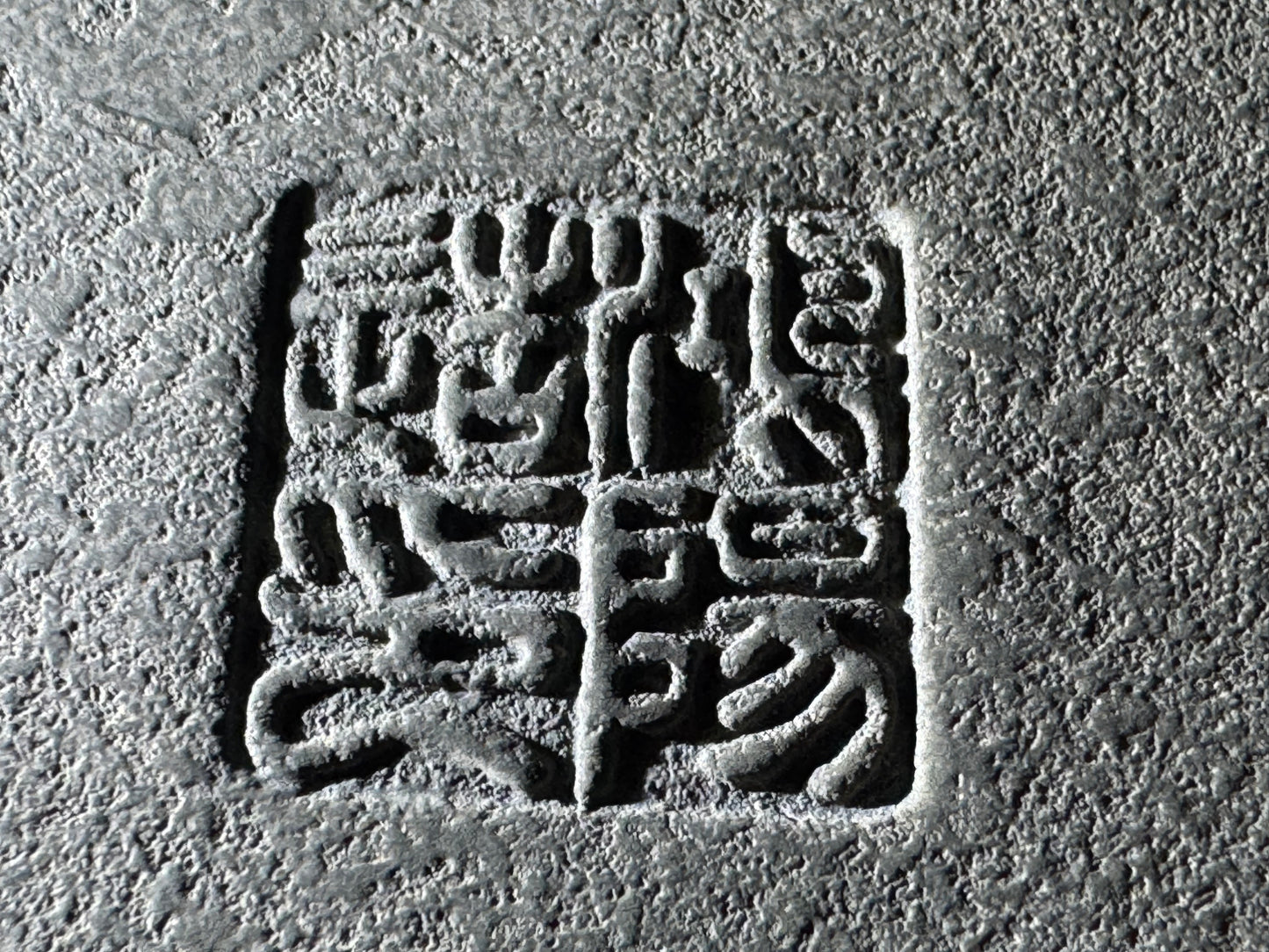
The underside bears a clearly impressed square KOYO kiln seal(鴻陽角印).
The deeply impressed and well-preserved 鴻陽印 provides an important point of identification and adds further collector interest(収集価値)to the piece.
External Dimensions / 外寸: 32.5 × 32.5 × 7.7cm
Internal Dimensions / 内寸: 28.0 × 28.0 × 6.7cm
Condition / 状態: Excellent condition / 状態良好. No cracks or repairs. The surface and interior display natural evidence of age and previous cultivation consistent with a vintage Japanese bonsai container.
Free Shipping to UK Mainland / 英国本土送料無料
About the Potter / 作家について – AIBA KOYO 鴻陽 / AIBA Kouichirou 相場恒一郎
Mr. AIBA Kouichirou (相場 恒一郎, 1944–2015), known in the bonsai world as KOYO(鴻陽), was a respected Tokoname bonsai-pot craftsman working in Tokoname, Aichi Prefecture(愛知県常滑市), one of Japan's historically important ceramic centres and one of the Six Ancient Kilns of Japan(日本六古窯 – Nihon Rokkoyo).
KOYO's work is recognised for its command of traditional bonsai-pot forms(伝統的な盆栽鉢の造形), carefully controlled proportions(均整), practical construction(実用性)and refined surface treatments. His pots demonstrate a strong understanding of the relationship between tree and container(樹と鉢の調和), seeking 調和(chowa – harmony) rather than allowing the container to dominate the bonsai.
His repertoire included both glazed(施釉)and unglazed(無釉)containers across numerous traditional forms. Particular attention was given to the relationship between rim(縁), body(胴), decorative or structural bands(帯), and feet(足), giving many of his pots a carefully considered architectural quality.
KOYO died in 2015, meaning his surviving pots now represent the completed body of work of an established Tokoname craftsman. Distinctive examples displaying unusual forms, clay treatments or decorative features are consequently of particular interest to collectors of Japanese bonsai ceramics(日本盆栽陶芸).
Collector's Note / コレクターズノート
This 32.5cm AIBA KOYO 鴻陽 is particularly interesting because the Taiko concept(太鼓意匠) extends beyond the basic round shape and is expressed throughout the construction and decoration of the vessel.
The two staggered rows of 鋲飾り, the unusual triangular stud composition(三角形の鋲飾り), and the incised reinforcing 胴帯 work together to reference the metal fastenings and reinforcing bands associated with traditional drum construction. The design therefore has a clear relationship between 形(katachi – form) and 意匠(isho – decorative concept).
The lower construction is equally noteworthy. The three integrated cut feet(三ヶ所の切足) emerge directly from the basal structure rather than being separately attached or recessed, allowing the strong circular silhouette to remain visually dominant.
Combined with the unusual muted grey-green unglazed clay(灰緑色の無釉土), granular 土肌, mature 経年変化, and clearly impressed 鴻陽角印, the pot has considerable individuality and 鑑賞価値(kansho kachi – aesthetic/collector interest).
It is a particularly attractive example of the Japanese principle of 用と美の調和(yo to bi no chowa – harmony between function and beauty), combining the practical requirements of a bonsai container with the traditional visual language of the 太鼓(taiko) in a restrained and highly distinctive form.
Share