

Sugi Bonsai
TERAHATA Mazan (Mayama Mazan) 寺畑真山 – 常滑 – 45.6cm Square 正方鉢 – Unglazed 無釉
TERAHATA Mazan (Mayama Mazan) 寺畑真山 – 常滑 – 45.6cm Square 正方鉢 – Unglazed 無釉
Couldn't load pickup availability
Product Details / 鉢の詳細
Region / 産地: Tokoname 常滑市, Aichi Prefecture 愛知県, Japan 日本
Kiln / 窯元: Mazan Kiln 真山窯
Potter / 作家: Terahata Mazan / Mayama Mazan 寺畑真山
Form / 形状: Square 正方鉢 / Seihobachi
Finish / 仕上げ: Unglazed 無釉 / Muyu
Mark / 落款: Impressed seal and hand-incised signature 真山
Description / 説明:
A substantial vintage artisan-made Japanese bonsai pot 日本盆栽鉢 by Terahata Mazan / Mayama Mazan 寺畑真山, produced in Tokoname 常滑市.
The pot is formed in a broad, powerful square shape 正方鉢 (seihobachi) with gently softened corners and a strong architectural presence. Despite its considerable 45.6cm size, the proportions remain controlled and balanced, creating an excellent sense of 安定感 (anteikan – stability) and 美的均衡 (biteki kinko – aesthetic balance).
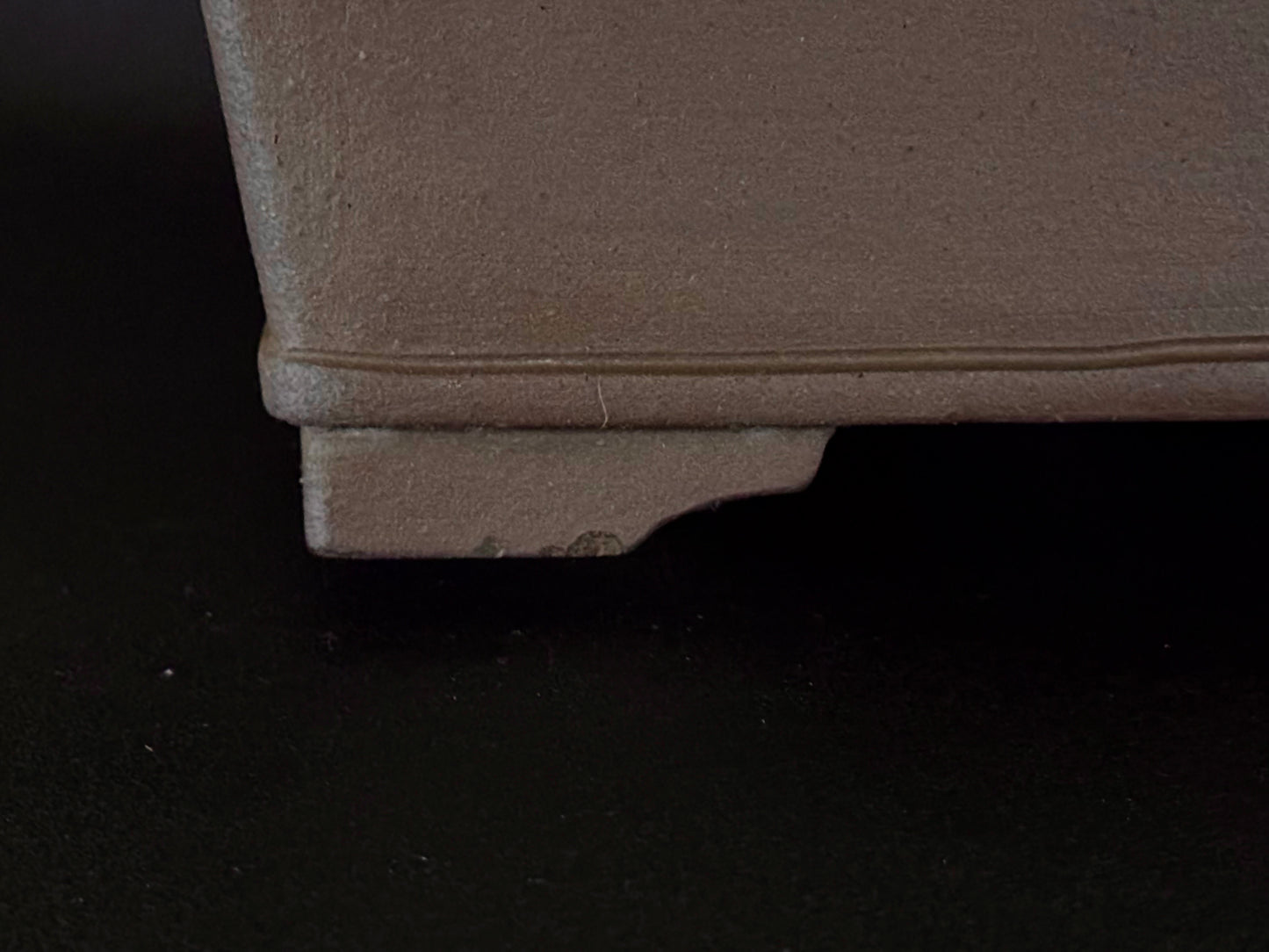
The upper profile is particularly refined. A broad projecting lip 口縁 (koen) runs continuously around the pot and is finished with a delicate raised border 縁取り (fuchidori) following the complete square contour. This subtle raised detail adds definition and refinement to the upper edge without making the rim appear heavy, contributing strongly to the pot’s 造形美 (zokei-bi – beauty of form).
The body 胴 (do) remains restrained and clean, allowing the natural proportions of the pot and the character of the clay to take precedence over unnecessary decoration.
At the base, the pot is supported by four substantial stepped corner feet 段足 (dan-ashi). Their stepped profile gives the large vessel a broad, secure stance while maintaining a refined transition between body and base. The feet follow the square geometry of the pot closely, reinforcing its strong architectural character.
The unglazed Tokoname clay 常滑無釉土 displays a warm reddish-brown to chocolate-brown tone with subtle natural variation across the surface. The exposed clay shows attractive 土味 (tsuchi-aji – character of the clay) together with developing 景色 (keshiki – surface character from age and use). The interior and underside display further tonal variation consistent with a mature, well-used unglazed bonsai pot.
The planting chamber is deep and generously proportioned, providing substantial root space suitable for a mature bonsai while preserving the strong exterior proportions.
The drainage system is especially comprehensive. The base incorporates 9 drainage holes 水抜き穴 (mizunuki-ana) together with 8 wiring holes 針金穴 (harigane-ana). This provides excellent 排水 (haisui – drainage) and numerous anchoring points for securely fixing a substantial tree within the pot.
The underside 鉢底 (hachizoko) carries both an impressed seal 印 (in) and the hand-incised 真山 signature, important identifying features associated with Terahata Mazan’s work and of particular interest to collectors.
The combination of the broad bordered lip, clean square body, substantial stepped feet and warm unglazed Tokoname clay gives this pot a particularly strong sense of 渋み (shibumi – understated refinement), 品格 (hinkaku – dignity) and 造形美 (zokei-bi).
External Dimensions / 外寸: 45.6 × 45.5 × 13.0cm
Internal Dimensions / 内寸: 39.2 × 39.0 × 10.6cm
Condition / 状態: Very Good! 良好な状態です。
The pot presents extremely well overall. There are two small chips located towards the back, one on each side of the pot. Their position means they are not noticeable when the pot is displayed from the front, making them particularly discreet when the pot is presented with a bonsai at an exhibition or show. They do not affect the structure, stability, or functionality of the pot. Please refer to the photographs for their exact location and condition.
Free Shipping within UK Mainland / 英国本土送料無料
Collector’s Note / コレクターズノート
Terahata Mazan 寺畑真山, also known as Mayama Mazan, is a recognised Tokoname bonsai potter associated with the Mazan Kiln 真山窯.
Collectors particularly value examples that show the combination of a clear impressed seal and the hand-incised 真山 signature. These marks are important attribution features and help distinguish individually worked Mazan pieces from more anonymous Tokoname production.
Mazan’s work is especially appreciated for strong, balanced forms, restrained detailing and careful use of unglazed Tokoname clay. His pots often rely on proportion, foot construction, rim treatment and 土味 (tsuchi-aji) rather than excessive surface decoration, making them particularly suitable for mature bonsai where the container should support rather than dominate the composition.
This large square example demonstrates those qualities particularly well. The broad projecting 口縁 (koen) with its delicate 縁取り (fuchidori), substantial 段足 (dan-ashi), generous planting volume, complex drainage arrangement and mature unglazed surface combine to create a pot with both practical strength and considerable collector appeal.
The presence of both the impressed seal and hand-incised 真山 signature further strengthens the attribution and makes this a particularly desirable example for collectors of traditional Tokoname bonsai ceramics.
Share